Battery energy storage system (ESS) adoption continues to accelerate across the U.S. Utility providers, hospitals, and multifamily properties rely on lithium-ion systems to control demand charges and support resilience. At the same time, insurers report higher loss severity from battery fires, which is reflected in premiums and underwriting requirements. Many jurisdictions also updated fire codes to address new chemistries and system sizes.
Building owners who rely on outdated fire protection plans face a widening compliance gap. Installing advanced energy storage without updating the overall safety strategy creates preventable liability and operational exposure.
The NFPA 855 2026 Edition Updates
The latest National Fire Protection Association (NFPA) standard for the Installation of Stationary ESS, NFPA 855, expands battery chemistry coverage, adds hazard mitigation analysis and large-scale fire testing, and introduces new emergency response requirements. Facilities with large battery systems, such as airports and data centers, should pay close attention to these updates.
Though compliance with this standard is voluntary, state and local jurisdictions routinely adopt it for their fire codes. The 2026 edition shows rapid growth in system size and chemical diversity — two changes that require immediate attention from occupied facilities.
Mandatory Hazard Mitigation Analysis for All Projects
The 2026 edition strengthens Hazard Mitigation Analysis (HMA) requirements. It evaluates fire, explosion, and toxic gas hazards specific to a proposed installation. The analysis must address the system:
- Chemistry
- Layout
- Ventilation
- Detection
- Suppression
The HMA must define safe distances, outline emergency responses, account for worst-case failures, and model hazards. For example, thermal runaway propagation across racks is a prime ignition source.
For facility managers, this is not just a paperwork exercise. The HMA now drives design approvals, inspection frequency, and emergency planning. If retrofits occur, the updated HMA applies to the upgraded portion.
Expanded Scope as New Chemistries Are Now Regulated
The 2026 edition expands the scope to cover emerging chemistries and hybrid systems. Lithium iron phosphate, nickel-manganese-cobalt, and sodium-ion configurations now receive more detailed treatment. Flow batteries and hybrid ESS paired with solar or generators also face clarified requirements.
The standard refines thresholds when more fire barriers, explosion control or deflagration venting are needed. It addresses indoor installations that exceed the previous megawatt-hour limit, which often trigger new construction and retrofit obligations for large commercial buildings.
Why 2026 Standards Are Stricter
With several high-profile incidents in the USA, such as the Gateway Energy Storage facility fire in May 2024, energy storage fires are drawing national attention. These incidents involved extended burn times and complex suppression efforts, with data showing longer on-scene engagement times compared to conventional electrical fires.
Here’s what this means for key stakeholders:
- Regulators: Regulators respond with more conservative design assumptions, seeking stronger separation from occupied areas and earlier detection of off-gassing.
- Insurers: Insurers are tightening underwriting. Many now require documented HMA reports and proof of compliance with adopted editions of NFPA 855.
- Building owners: For building owners, stricter standards reduce ambiguity while raising the bar for documentation, inspection, and operational readiness.
The Critical Role of Fire Watch in Your Safety Strategy
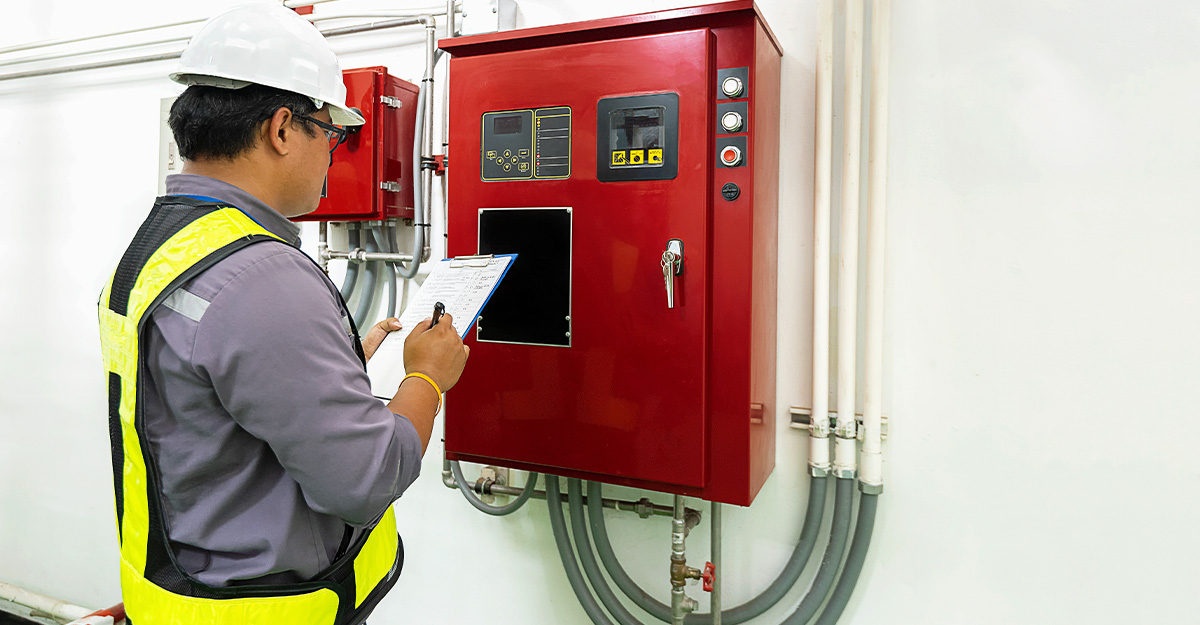
Advanced detection and clean-agent systems protect modern ESS rooms, yet each system has vulnerabilities. Protection may be impaired during installation, commissioning, or maintenance. Sensors may be offline, suppression cylinders may be disconnected, or panels may be in test mode. Yet your facility still operates, and critical energy loads continue.
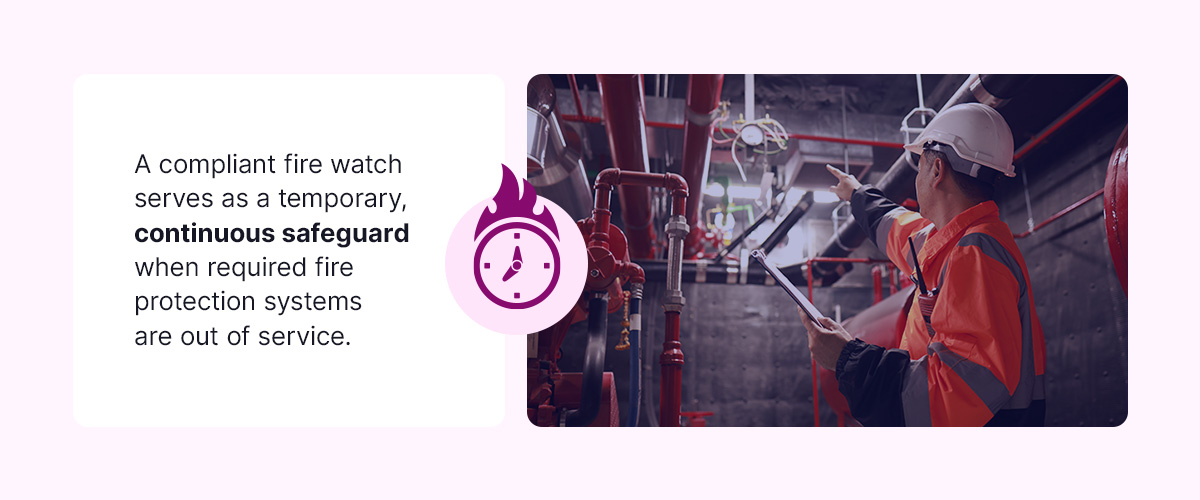
A compliant fire watch serves as a temporary, continuous safeguard when required fire protection systems are out of service. Fire watch personnel conduct patrols, monitor affected areas for signs of fire, and maintain direct communication with emergency services. They will document any findings in accordance with the local code and the authority having jurisdiction (AHJ) requirements.
This coverage is not optional. It is a defined life safety function under the fire code when protection is impaired.
Bridging the Gap During Installation and Commissioning
When automated systems are offline, the risk profile changes immediately. Heat or smoke may go undetected, shrinking early intervention windows. A structured fire watch bridges this gap. Trained personnel maintain constant vigilance, identifying abnormal odors, visible vapor, or unusual heat signatures. These guards will start emergency response without delay when required.
For occupied facilities, this bridge protects people and operations while technical teams complete their work.
Mandatory Coverage During System Maintenance and Outages
NFPA 855 places special emphasis on fire watch whenever fire detection or suppression systems are taken out of service for any reason. Most fire codes require a fire watch when a built-in fire protection systems are impaired and not restored within a set time. This rule applies to ESS rooms with mandated detection or suppression.
During planned maintenance, building owners must notify the AHJ and, often, their insurer. They must follow an approved impairment plan, which includes a fire watch as a central component.
For unplanned outages, response must be immediate. If suppression fails or a control panel faults, the facility cannot wait for the next business day. Coverage must begin immediately and continue until full protection is restored.
Ensuring 2026 Compliance
Compliance requires coordination across engineering, operations, and risk management, with two steps standing out for reducing exposure and strengthening defensibility:
Auditing Your Current Fire Safety Profile
Start with a documented audit, confirming which edition of NFPA 855 your jurisdiction adopted:
- Inventory ESS, electric vehicle charging and other electrical systems
- Verify compliance with UL 9540A Large-Scale Fire Testing protocols
- Verify that separation distances, fire ratings, and ventilation match current requirements
- Review detection and suppression design
- Review storage systems design and installation per NFPA 855
- Confirm system capacity aligns with the current ESS size and chemistry
Document every finding, as insurers and fire officials expect written records.
Integrating Fire Watch Into Your Emergency Response Plan
Update your emergency response plan to include ESS scenarios. Define triggers for fire watch activation and include time-stamped logs in incident reports. Additionally:
- Train staff on how to quickly request fire watch services
- Maintain contact information for qualified providers who understand ESS hazards
- Preapprove contractual terms to avoid delays during an emergency
You Need a Fire Watch Partner — Trust Us
National Firewatch supports building owners facing complex ESS risk. We provide compliant fire watch services across commercial and industrial facilities, with teams that understand the legal definition of fire watch and the operational demands of occupied properties:
- Our team coordinates with facility managers, contractors, and authorities with jurisdiction
- Our personnel follow structured patrol routes, maintaining detailed logs
- Guards immediately respond to signs of fire, notifying emergency services
For ESS projects, we align coverage with the HMA and impairment plan. When suppression systems are offline, coverage starts on schedule and stays in place, delivering continuity, documentation, and defensible compliance.
Proactive ESS Risk Management
Energy storage delivers efficiency and resilience. It also introduces new fire dynamics that demand disciplined oversight. 2026 NFPA 855 compliance reinforces that reality through stricter HMA requirements and expanded scope. For occupied facilities, compliance affects operations, maintenance scheduling, emergency planning, and insurance relationships. Fire watch plays a defined role when protection systems are impaired, bridging critical gaps and protecting occupants.
National Firewatch supports your ESS strategy. Within hours of your request, we can deploy fire guards for commercial and residential properties, construction sites, or events. From planned maintenance to unexpected outages, we offer structured, code-aligned coverage tailored to your facility.
Contact us today to secure compliant coverage and protect your people, property and operations.