
Record-breaking heat is hitting the Southwest, with temperatures shattering historical benchmarks. As spring intensifies, atmospheric instability drives a volatile spring storm season across the central and southern United States.
Extreme weather threatens more than comfort or convenience. It dismantles the electrical infrastructure that powers fire detection, suppression and alarm systems. Power-dependent fire safety measures go dark as the grid goes offline, leaving properties vulnerable. Here are insights from National Firewatch on how climate patterns and power outages cause on-site fire risk.
Key Takeaways
Extreme weather translates into fire safety vulnerabilities through several critical links:
- Weather volatility: Supercharged storms exceed the thresholds the electrical infrastructure was designed to handle. This intensity causes widespread and prolonged power outages.
- Fire safety systems: Fire alarms, smoke detectors, sprinkler pumps and emergency communication systems stop functioning when the grid goes offline.
- Fire hazards: Downed power lines become active ignition sources, while facilities lose the ability to detect or suppress fires electronically.
- Manual fire watch: During system failures, trained human monitors provide the only viable countermeasure for fire safety and regulatory compliance.
The Impacts of Extreme Weather
A warmer atmosphere holds more moisture and energy, altering weather patterns. Each degree of warming allows air to hold roughly 7% more water vapor, acting as fuel for intense storms.
Most of our country’s power infrastructure was engineered for the climate conditions of decades past, not for today’s changing weather. Grid infrastructure now operates at the edge of its tolerance limits during destructive weather events.
Intense weather manifests in forms that directly threaten grid stability:
- Intense thunderstorms: Clusters of powerful storms produce damaging winds, lightning strikes and heavy rainfall that can persist for hours across wide regions.
- Derechos and straight-line winds: Fast-moving windstorms generate sustained hurricane-force gusts capable of snapping utility poles and toppling transmission towers.
- Flash and river flooding: Flooding substations and underground electrical equipment cause cascading failures and extensive repair work.
- Heat domes and temperature extremes: Prolonged periods of excessive heat cause power lines to sag and drive electricity demand for cooling.
- Drought conditions: Extended dry periods weaken tree root systems, making vegetation more susceptible to toppling onto power lines during moderate winds.
Climate scientists anticipate a forward-looking threat amplifier that compounds these risks. According to the NOAA El Niño Watch, there’s a 62% chance of El Niño conditions emerging by summer, which can intensify drought in some regions while triggering destructive storm outbreaks in others.
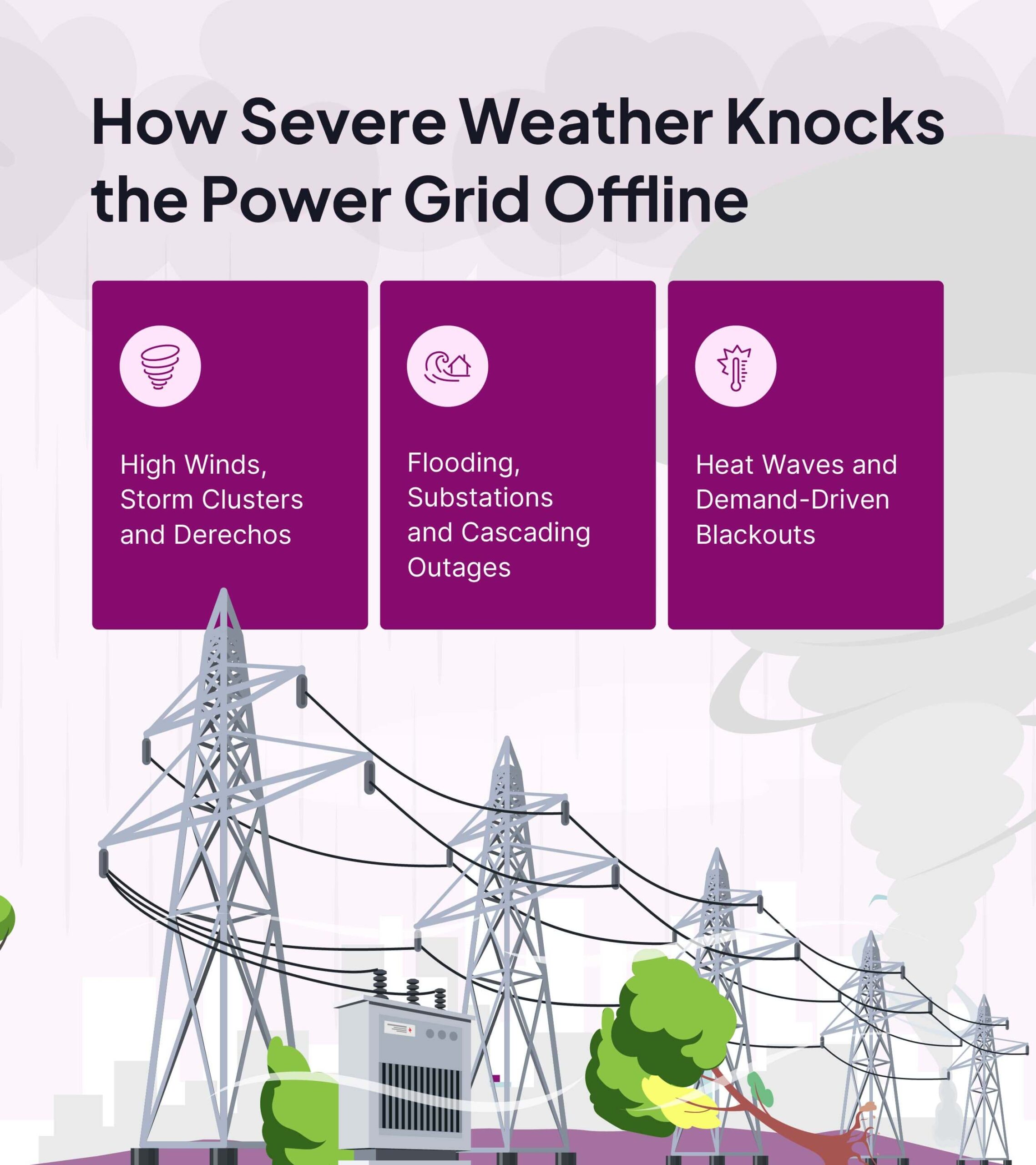
How Severe Weather Knocks the Power Grid Offline
Understanding the mechanisms of weather-related grid failures helps facility managers expect vulnerabilities and plan accordingly. Three primary pathways account for most outages during extreme weather events:
1. High Winds, Storm Clusters and Derechos
Physical force from high winds represents the most common cause of weather-related power outages. Thunderstorms routinely produce gusts exceeding 60 mph, strong enough to snap tree limbs and hurl debris into power lines. Multiple intense storms tracking across the same region in quick succession can leave hundreds of thousands of customers without electricity for days through cumulative damage.
Derechos — a widespread, long-lived windstorm associated with rapidly moving thunderstorm clusters — represent an extreme manifestation of wind-driven grid failure. These rare but devastating events produce sustained winds of at least 58 mph across paths stretching 240 miles or more. May through August sees 70% of all derecho occurrences.
When one of these systems tracks through populated areas, the damage to electrical infrastructure can be catastrophic, knocking down thousands of utility poles and leaving entire metropolitan regions in the dark.
2. Flooding, Substations and Cascading Outages
Heavy rainfall and flooding pose unique threats to electrical infrastructure. Substations with high-voltage transmission lines connecting to lower-voltage distribution networks often include ground-level equipment that is vulnerable to inundation. Automatic safety systems trigger shutdowns as floodwaters reach sensitive components, preventing electrocution hazards and equipment damage.
For example, in 2012, Hurricane Sandy provided a stark illustration of grid failure driven by flooding in New York City. The record storm surge knocked out the Con Edison East 13th Street Substation, plunging lower Manhattan into darkness for days. This shows how a single flooded substation can cascade into widespread outages affecting hospitals, high-rise buildings and emergency services.
Unlike wind damage that utilities can often repair within hours, flood-related electrical failures require extensive drying, testing and equipment replacement before power can be safely restored. Extended restoration timelines like these create prolonged periods when buildings must operate without technology-based fire safety systems.
3. Heat Waves and Demand-Driven Blackouts
Extreme heat threatens grid stability through two distinct mechanisms. First, high temperatures cause power lines to expand and sag physically. Utilities must de-energize transmission lines that droop too close to vegetation or structures, preventing fires but resulting in intentional outages. Second, heat drives record electricity demand as millions of air conditioning units strain to cool buildings, pushing the grid toward its maximum capacity.
Heat records underscore the growing severity of this threat. On March 18 and 19, 2026, multiple locations across the Southwest recorded temperatures that would have been virtually impossible without climate change. Heat waves now occur earlier than expected and at record-breaking temperatures. This can catch unprepared utilities and facility managers off guard during a time when power demand would traditionally be moderate.
From Power Failure to Fire Risk
A power outage systematically dismantles the fire safety infrastructure that modern facilities depend on. Immediate fire safety crises emerge from downstream effects:
- Downed power lines become active ignition sources: Storms that knock out electricity often leave energized lines on the ground or draped across vegetation. This can spark
 wildfires and structural fires until crews can de-energize and repair them.
 - Fire alarm systems go silent: Fire alarms and smoke detection systems in buildings lose power, eliminating the electronic early warning that allows occupants to evacuate before conditions become deadly.
- Suppression systems become inoperable: Sprinkler systems that rely on electric pumps to maintain water pressure stop functioning. This removes the primary defense against fire spread in large commercial and residential buildings.
- Emergency communication networks go dark: Public address systems, emergency lighting and communication infrastructure that coordinates evacuation and emergency response all depend on continuous electrical power.
 wildfires and structural fires until crews can de-energize and repair them.
This convergence of failures shows why preparing for fire watch during extreme weather has become a critical planning priority. Fire risks comparable to buildings constructed before modern safety codes existed now threaten facilities when all power-dependent fire safety measures fail simultaneously.
The Eight-Week Outlook
Late March through May marks the peak period for weather-related grid failures across much of the U.S. Official meteorological data, combined with known seasonal patterns, in this forecast, provides facility managers with a forward-looking risk assessment.
Late March to Early April
An upper-level ridge producing record-challenging heat across the western U.S. is increasing electricity demand and fire-weather risk. It’s also speeding up early-season snowmelt in the western mountains. Power demand surges, which drive this early-season heat wave, stress grid capacity when utilities would traditionally have comfortable reserve margins.
Facility managers in the southwestern states face a dangerous combination of elevated fire risk and strained grid capacity. Dry conditions and high temperatures turn vegetation into tinder, while the electrical infrastructure that powers fire suppression systems operates near its limits. Early-season heat also accelerates snowmelt in mountain ranges, which can later contribute to flooding downstream as runoff overwhelms river systems designed for more gradual spring thaws.
Peak Risk in April
April historically brings elevated risk for intense thunderstorms, high winds and tornadoes. Across the Mississippi Valley and Gulf Coast states, billion-dollar weather disasters are increasingly common. Violent storm clusters account for a significant part of the economic damage.
Winter-to-summer atmospheric transitions create instability during this seasonal weather peak, fueling explosive thunderstorm development. Resulting storms can knock out power across multistate regions, leaving properties without electronic fire protection for extended periods. Facility managers in these regions should be proactive, with fire watch contingency plans in place before storm season peaks.
Late April to May
Heat domes can expand into late April and May, straining electrical grids and rapidly drying out vegetation. Driving temperatures above normal for weeks at a time, these persistent high-pressure systems trap heat near the surface.
Extreme heat from climate change is increasingly threatening U.S. energy supply and reliability. By 2050, billions of dollars in economic value and up to 18% of U.S. generating capacity could be exposed to heat risk. Electrical infrastructure strain during heat dome events creates a vicious cycle. Increased cooling demand pushes the grid toward failure, while those failures disable the cooling systems and fire suppression equipment that buildings need most.
Dangerous fire weather conditions also come from heat domes, combining high temperatures with low humidity and persistent winds. Fire danger escalates rapidly when these atmospheric patterns settle over regions experiencing drought. A single spark from damaged electrical equipment or a lightning strike can ignite vegetation that burns with exceptional intensity under these conditions.
May and Tornado Alley
May through early June marks the statistical peak for tornado activity in the central plains. Significant risk of grid damage from destructive storms arrives during this period, with tornadoes often accompanied by large hail, damaging straight-line winds and flash flooding.
Challenges from heat and violent thunderstorms that facility managers already face become compounded by the tornado threat. A single tornado can destroy transmission infrastructure across a miles-long path, while intense thunderstorms that spawn tornadoes knock out power across much wider areas through wind damage and lightning strikes. Entire regions can remain without power after the most intense tornado outbreaks, leaving facilities reliant on backup fire safety measures for extended periods.
Why Fire Watch Becomes Essential When the Power Goes Out
Power-dependent fire safety systems become inoperable during outages, making manual human monitoring the only viable countermeasure. Professional fire watch services address specific vulnerabilities:
- Inoperable fire detection: Electronic systems require continuous electrical power to function. Buildings lose the ability to detect fires in their early stages and suppress them before they spread as that power goes offline.
- Heightened fire hazards: Power outages often occur during intense weather events and create more fire risks, including downed power lines, lightning strikes and disrupted emergency services responding to multiple simultaneous incidents. Regular fire watch drills, scenario-based grid-outage risk assessments and staff cross-training all enhance resilience.
- Regulatory and compliance: The National Fire Protection Association (NFPA) standards require a fire watch during periods when electronic fire protection systems are impaired or out of service. Maintaining compliance during extended outages protects you from regulatory penalties.
- Critical need for human vigilance: Trained fire watch guards provide continuous, 24/7 monitoring to detect fires early. This ensures emergency services can be contacted immediately and that compliance with fire codes is maintained during outages of any duration.
As outages become more common, regulators may tighten compliance windows and require digital logs of fire watch patrols. Fire watch personnel operate independently of electrical infrastructure, using visual patrols, communication equipment with backup power and direct coordination with emergency services to maintain fire safety when technology-based systems stop functioning. Continuing to function regardless of grid status, weather conditions or infrastructure damage, this human element provides a layer of protection.
A New Era of Preparedness
Extreme weather drives power failures, which disable the electronic systems that facilities depend on to detect and suppress fires. Relying solely on technology that requires uninterrupted electricity is no longer a sufficient safety strategy.
Manual fire watch has become a fundamental part of resilient property management. As such, professional fire watch services are crucial for commercial properties and emergency scenarios, including residential facilities, hot worksites, construction zones and special events. Trained guards deliver continuous, 24/7 monitoring that operates independently of the grid, ensuring early fire detection and compliance with OSHA and NFPA standards during system outages.
Preparedness must evolve as climate patterns intensify and grid vulnerabilities multiply. Fire watch is no longer a reactive measure reserved for emergencies — it’s a proactive safeguard that belongs in every modern facility safety plan.